AI Agent vs AI Assistant: Which One Does Your Enterprise Need?
Share this blog:
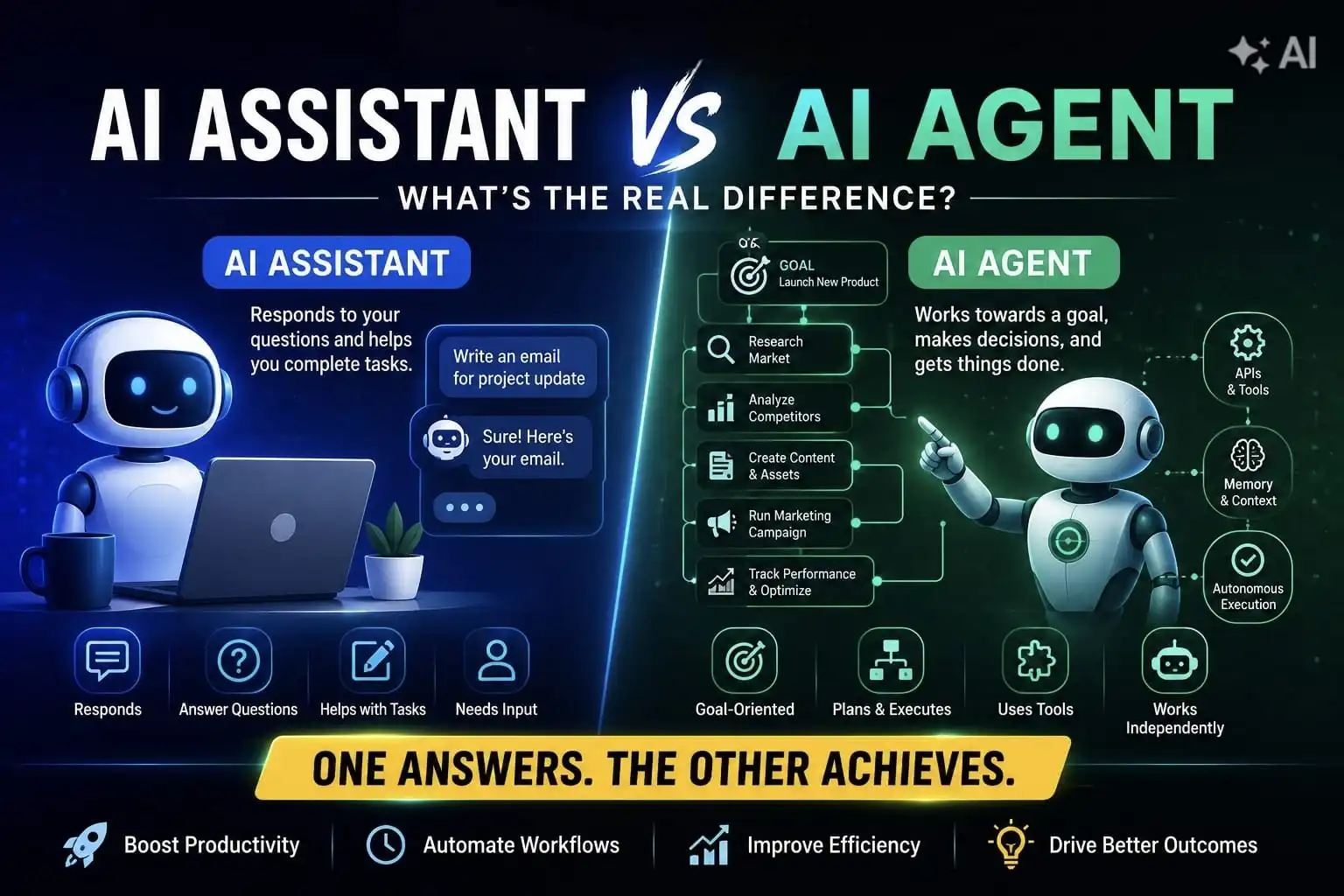
60 Second Summary:
If your team can't tell how an AI assistant differs from an AI agent, you're already building the wrong thing. It's not just a mix-up. Point your budget at the wrong one, and the project stalls before it ever pays for itself. In this blog, you will learn the key differences between AI agent and an Assistant, and which one you should choose for your business.
An AI assistant waits for you to ask something, then answers, plans analysis, or summarizes.
That's the whole job.
Whether it's Microsoft copilot summarizing the meeting notes, or an internal chatbot pointing an employee to the right HR policy, all of these are examples of AI assistants.
Think of it this way: if you close the tab and walk away, nothing happens. The assistant goes idle until you come back.
The architecture behind this is simple.
A human sends the prompt; the model checks it against context, like a document or knowledge base, and responds. There's no decision-making between.
The assistant has no internal evaluation loop. It can't look at what it just produced and decide on its own that a second task should follow, spin up an external script, or call a new API endpoint. Every one of those needs an explicit instruction from you first.
An agent doesn't wait around for the next prompt. Give it a goal, a trigger, and a set of rules once, and it plans a path to that goal, picks up the tools it needs, takes the actions, and keeps going until the job is done.
Take invoice processing as an example. An agent doesn't just tell you what the invoice says. It cross-checks the purchase order, flags a mismatch, routes it for approval, and updates the finance system once it's resolved. Nobody prompted it at each step.
That takes more groundwork than a simple assistant needs.
The agent runs on a reasoning-and-acting loop. You give it an objective. The model evaluates the goal, picks up a tool from whatever it has access to whether that's a python interpreter, a web scraper, or an internal API and runs it.
From there, it reads the result, whether that's a clean output or an error code, and decides what to do next based on what it just saw. Then it repeats that loop, tool call after tool call, until the objective is actually met.
An agent keeps observing its own output and reacting to it, which is exactly what lets it recover from a failed step instead of just handing you an error and waiting for new instructions.
Here's a quick summary of how they differ in decision-making, memory, and execution capabilities.
Basis of Comparison | AI Assistant | AI Agent |
Meaning | AI assistants like Siri, Google Assistant etc. execute the tasks along with other enterprise chatbots. | AI Agents decide, analyze data, predict outcomes and perform autonomous decision-making. |
Primary role | Supports the person doing the work. | Completes the work itself |
What Triggers it | A human prompt | A defined goal |
Decision Making | Limited, mostly retrieval and drafting | Autonomous, multi-step |
Tool and API usage | Optional, often minimal | Extensive, core to the job |
Workflow execution | One question, one answer | Multi-question, end-to-end |
Memory | Usually resets each session | Persists across the task |
Learning and adaptation | Basic personalization based on your preferences | Learns from past outcomes and adjusts as conditions change |
Human oversight needed | Continuous, every interaction | Exception-based only |
Build and governance complexity | Lower | Higher |
Optimization | Optimized for productivity | Optimized for business process automation |
Examples | Siri, Google Assistant, Alexa, ChatGPT, Perplexity, Gemini, Custom GPTs, etc. | Customer service agents handling full resolutions, trading agents, logistics agents, etc. |
Decision Making | Human makes the final decision | Agents make predefined operational decisions. |
What is it built for? | Simplifying a routine, one task at a time | Automating a whole workflow or decision process |
Trigger | Triggered by user prompts | Triggered by events, schedules, APIs, or business rules. |
Best suited for | Best for knowledge work | Best for operational work |
Business Risk | Minimal business risk | Higher responsibility, requiring auditability and controls. |
Implementation | Lower implementation complexity | Requires governance, monitoring, and integration. |
Time to Deploy | Weeks | Months |
Keep reading for more details to understand the differences between an AI agent vs an AI assistant.
AI assistants work on the human-in-the-loop model. They respond to your prompt, need explicit instructions for each action, and never decide on their own what to do next.
In contrast, AI agents are built for independent execution. Once you've defined the objective, they interpret the goal, make decisions, and act with minimal oversight.
AI assistants are best suited for single-task support: answering a question, drafting content, or scheduling a meeting. Each task gets handled in isolation, with no connection to the one before or after it.
AI agents operate across multi-step workflows. They break a complex goal into smaller tasks, work through them in sequence, and adjust their next action based on how the previous one turned out.
Most AI assistants run on session-based responses, so they carry little to no memory once the conversation ends.
AI agents hold onto context across a task. They retain what happened before, learn from previous actions, and adjust their behavior as conditions change, which is what lets them get better at a workflow the longer they run it.
The simplest way to put it: assistants handle tasks; agents handle jobs.
AI assistants are best suited for single-task support, and they're best used for work that's genuinely lower in complexity: setting up a reminder, answering an FAQ, controlling a smart device, drafting a piece of content.
Each task gets handled in isolation, with no connection to the one before or after it.
AI agents are built to manage complex workflows that span multiple applications.
They can plan, coordinate, and execute a sequence of interdependent tasks, such as onboarding a new hire across HR, IT, and finance systems, with minimal human intervention once the process is set up.
People often think of an AI assistant = chatbot, and an AI agent = chatbot with tools. That's incomplete.
An AI assistant is like Google Maps. It tells you which road to take.
An AI agent is like a professional chauffeur. It drives the car, handles traffic, refuels when needed, reroutes after an accident, and gets you to your destination.
The real progression looks more like this:
Note: The jump from assistant to agent isn't simply access to APIs; it's autonomy. A system can have every integration in the world and still be an assistant if a human has to trigger every single step.
Choose an AI Assistant | Choose an AI Agent |
The task is simple and repetitive. | The workflow is multi-step and spans across multiple systems. |
Users need conversational support or guidance. | The system must execute actions autonomously. |
A human makes the final decision. | AI can make operational decisions within defined rules. |
The workflow doesn't require memory or orchestration. | Long-running workflows require memory, planning, and orchestration. |
The goal is to improve productivity. | The goal is to automate an end-to-end business process. |
Scheduling, a Q&A bot, or summarizing a document all fits here. | Workflow automation, orchestrating several tools at once, and research work all suit an agent better, since decision-making has to be more independent. |
This is where most of the real enterprise value shows up, and it's rarely "assistant or agent." The practical pattern looks like this: assistant, then a human decision, then agent execution.
For example, a sales manager asks which enterprise opportunities are at risk this quarter. The assistant analyzes the CRM and lays out
The manager reviews that and approves a plan. From there, the agent takes over:
The assistant supports the decision. The agent executes it. That handoff, not picking one tool over the other, is usually where the actual return on an AI investment comes from.
AI assistants help people work faster.
AI agents help businesses operate smarter.
Note: The most successful enterprises combine both, using assistants to sharpen human decision-making and agents to automate well-defined processes under clear governance.
Use Case | AI Assistant | AI Agent |
Searches the order, pulls up the shipment status, and drafts a response. A person still has to read it and hit the send.,The human owns the process from start to finish. |
Nobody had to ask it to do any of those steps step by step. | |
FinOps | An engineer asks which Kubernetes cluster is incurring the highest costs this month, and the assistant answers. That's the end of the interaction. |
|
Enterprise sales | Prepares meeting notes by summarizing the transcript, drafting a follow-up email, and suggesting the next steps. The salesperson still decides everything past that. | Once the call ends the agent -
|
Software Engineering | A developer asks the assistant to explain an exception and gets a walkthrough of the stack trace. That's where the interaction ends. |
|
Legal | Drafts an NDA and stops there. |
|
Healthcare | Summarizes a patient's history when a doctor asks for it. |
|
Our work isn't really about deploying a model; it's about integrating AI into how your business operates. Here's how our AI engineers will help you develop innovative AI solutions in many ways -
An assistant responds to what you ask it and stops there. An agent takes a goal, plans the steps, uses tools and systems on its own, and keeps working until the task is done.
Agents are better for multi-step, repetitive processes that don't need a human to check every action. Assistants are better for knowledge-heavy tasks where a person should review the output before it goes anywhere.
In a sense, yes. Many enterprises start with an assistant to prove a use case, then add planning, memory, and access to tools to turn parts of that workflow into an agent once they trust the results.
A chatbot, especially a rule-based one, follows a script and answers based on predefined logic. An agent reasons toward a goal, adapts its approach, and takes multi-step actions across systems without needing a script.
Yes, just not constant supervision. Well-built agents run on exception-based oversight, meaning a person only steps in when something falls outside the rules the agent was given.
Generally, yes. Agents need more infrastructure for planning, memory, and system integration, as well as ongoing monitoring to catch drift. Assistants are lighter to deploy and cheaper to maintain because a human reviews output at every step.
Most should. A common setup is for an assistant to handle the high-volume question-answering layer. At the same time, an agent runs the multi-step process behind it, like a support assistant answering customer questions while an agent handles the refund it triggers.


•
Sr. Technical Writer•
Articles