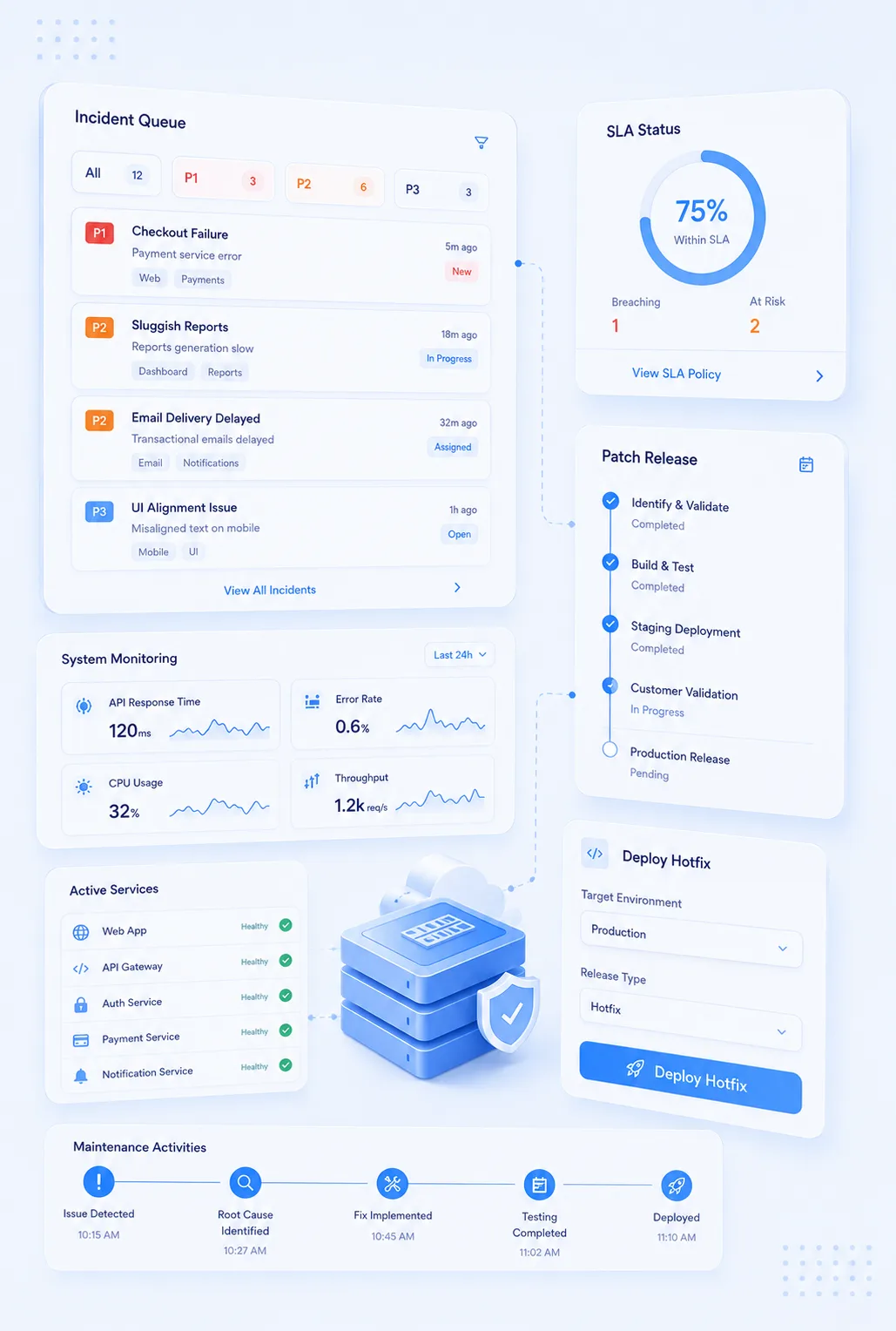









Our Software Maintenance Company model covers Product Technical support, corrective fixes, perfective work, and release care under one AMS plan.

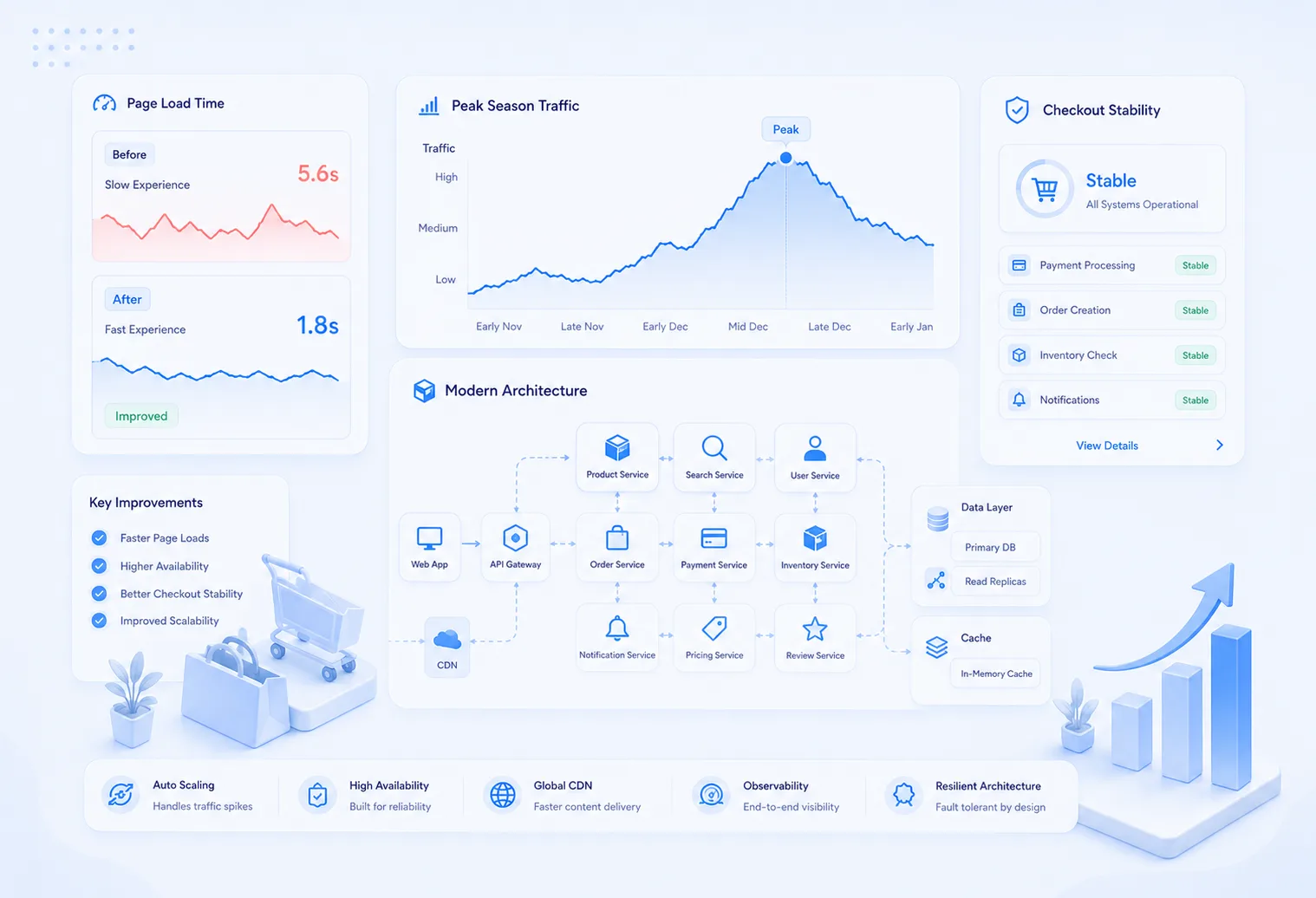
We cut page load from 7+ seconds to about 3 seconds and hardened a microservices stack that serves 9M+ users through peak retail traffic.
Page load 7+s → ~3s; 9M+ users; peak-season stability via microservices as published.
Software Maintenance and Support should shrink risk first, then free capacity for product work. We sequence AMS so critical defects, patches, and enhancements do not collide.
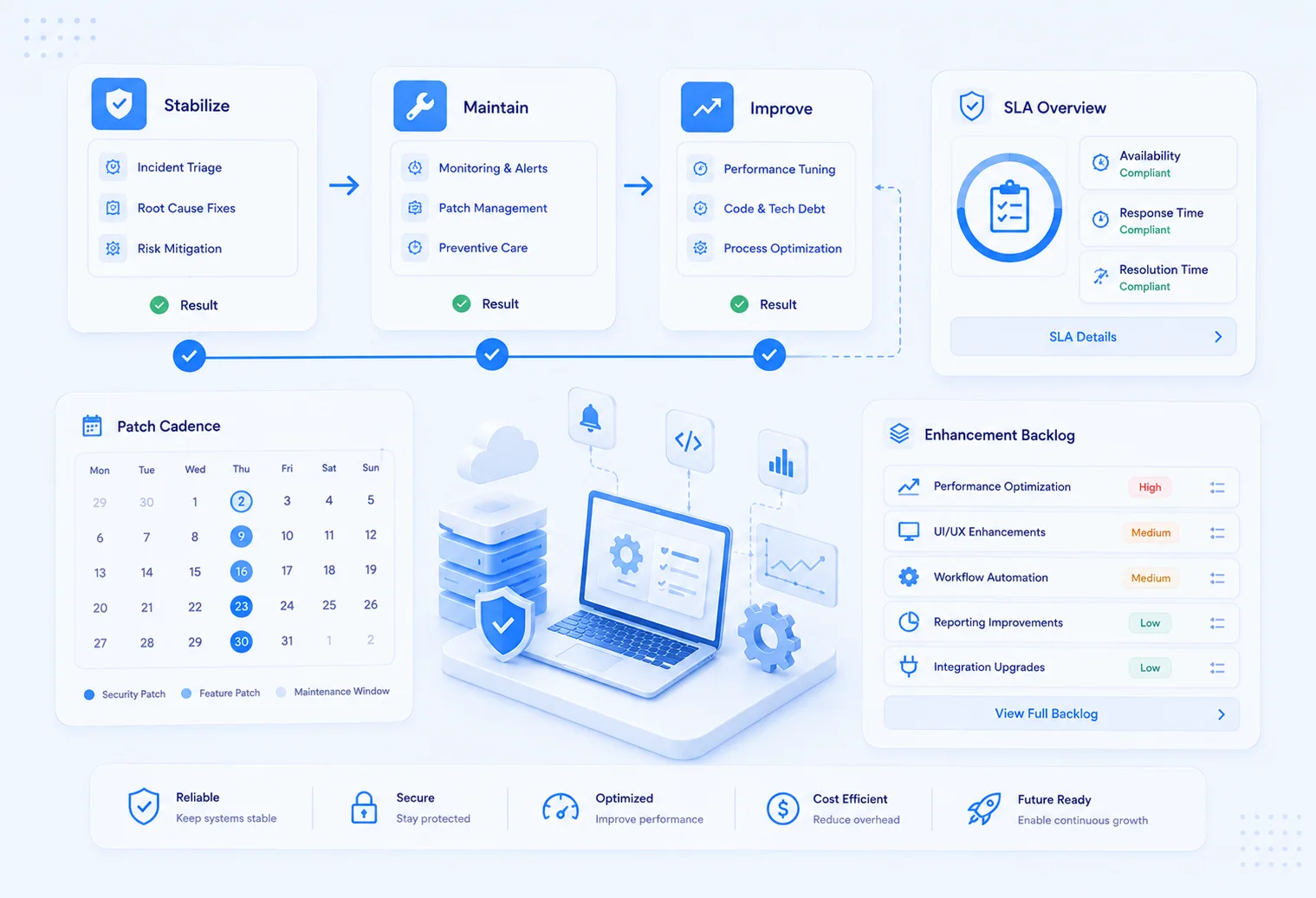
You need Software Maintenance and Support that shrinks production risk first - not a ticket mill that steals roadmap capacity.


We apply Product maintenance service patterns to the approval rules, peak windows, and audit needs your industry already runs.




Six stages move a live product from risk assessment to a steady AMS cycle with Result lines you can review each period.
Pricing is custom because severity mix, stack, and coverage windows differ. We share quality meaning and time-to-start before you commit to a retainer. Severity SLAs, regression checks before production, and maintenance reports each cycle. A scoped 40-hour free pilot can start after a short discovery call.
Fixed capacity for Product Technical support, patches, and a small enhancement bucket.
Flexible hours for incident spikes and project-shaped maintenance work.
Named engineers in your tools with shared sprint rituals.
These results come from published BigOhTech portfolio pages. We do not invent uptime percentages or MTTR claims for this service page.
Compare how production care usually lands when you buy hours, hire only inside, or partner with BigOhTech for Software Maintenance and Support.


Six common AMS shapes. Each still starts with a scoped pilot when risk or codebase access is unclear.


Software Maintenance Services cover the frameworks and platforms your product already runs - not a forced rewrite to our preference.

A Software Maintenance Company stays useful when it fits your cloud, VCS, and monitoring vendors without forcing a rip-and-replace.
Industry commentary citing Gartner notes that roughly 70% of software costs are often spent on Keeping the Lights On (KTLO) - routine maintenance that does not fund innovation by itself. That is why Product maintenance service needs clear ownership, not leftover hours. Worldwide IT spending is forecast at $5.61 trillion in 2025 (+9.8% YoY) per Gartner (21 Jan 2025). Budget growth still gets absorbed by operations unless you separate AMS from feature work.
Six capability areas that show up on live Product Technical support engagements.




You get a 40-hour free pilot on one production risk, product-engineering continuity with runbooks and release gates, and delivery under CMMI Level 3 appraised and ISO 27001 certified process. We do not sell anonymous ticket mills.
A scoped pilot can start after a short discovery call once access and risk cut are clear. Full retainer timelines depend on knowledge transfer and environment readiness.
Pricing is custom because severity mix, stack, and coverage windows differ. We share quality meaning, time-to-start, and a model (retainer, time and material, or dedicated pod) before you commit.
IT Support and Maintenance covers broader IT support framing on the live site. This page focuses on Software Support Services for live products: application AMS, release care, and product technical tiers.
We pick one incident class, release path, or stability risk, work it inside about 40 free hours, and score fit before a long retainer. You decide whether to expand without a multi-quarter lock first.
Yes. Takeover starts with access audit, knowledge transfer, and a stability sprint. We still prefer a pilot on one risk before you move the full AMS load.
Both. Corrective work stabilizes production; perfective capacity is reserved for measured enhancements so support load and usability can improve without a separate build program.
Yes. When debt or architecture needs a larger program, we path into Product Engineering or Product Modernization while AMS keeps the live surface stable.
P1 coverage outside business hours is available when your plan includes it. Severity definitions and response targets are written into the SLA on intake.
We offer AMS retainers, time and material support, or a dedicated pod so live products stay reliable as usage grows. See our IT Support and Maintenance page when infrastructure and app layers both need coverage.
Your product IP and repos stay yours under the MSA and SOW. We work under NDA for code, data, and runbook discussions.
Typical scope covers Product Technical support (L1–L3), incident response, bug fixes, security patches, version upgrades, monitoring and release support, and a measured enhancement capacity. Exact inclusions sit in the SLA and SOW after discovery.
Share your project goals, timeline, and technical requirements. We'll review your requirements and send a tailored solution with an indicative estimate within 48 business hours.