What is an AI Chatbot? How it Works, Types & Benefits
Share this blog:
It's 11 pm, and a customer on your website has a question about their order. Your support team logged off hours ago. They wait, maybe email, maybe just leave and buy from someone else instead.
This happens more than most businesses realize. Most customers expect an immediate response when they reach out for help, and when they don't get one, that's exactly where AI chatbots come in.
An AI chatbot is a computer program built to understand what someone's asking, respond in a natural, human-like way, and keep improving with every conversation, all without needing a human on the other end.
So, what makes it different from the old-school chatbots, and how does it work? Let's break it down.
AI chatbots are automated bots powered by AI technology. These chatbots simulate human-like conversations and offer real-time responses to customer or user queries along with performing other helpful tasks.
Traditionally, chatbots were quite limited in what they could do. You could type in a question, but unless it matched one of the few pre-written responses the developer had programmed, you wouldn’t get a useful answer.
They were purely text-based, designed to handle only a small list of basic queries. Anything outside that ‘list’ was like speaking a different language to them.
However, the AI chatbots are quite advanced as compared to traditional bots, they use machine learning (ML) algorithms to constantly improve themselves in terms of accuracy and understanding user queries. The longer an AI chatbot solutions has been in use, the more relevant are its responses.
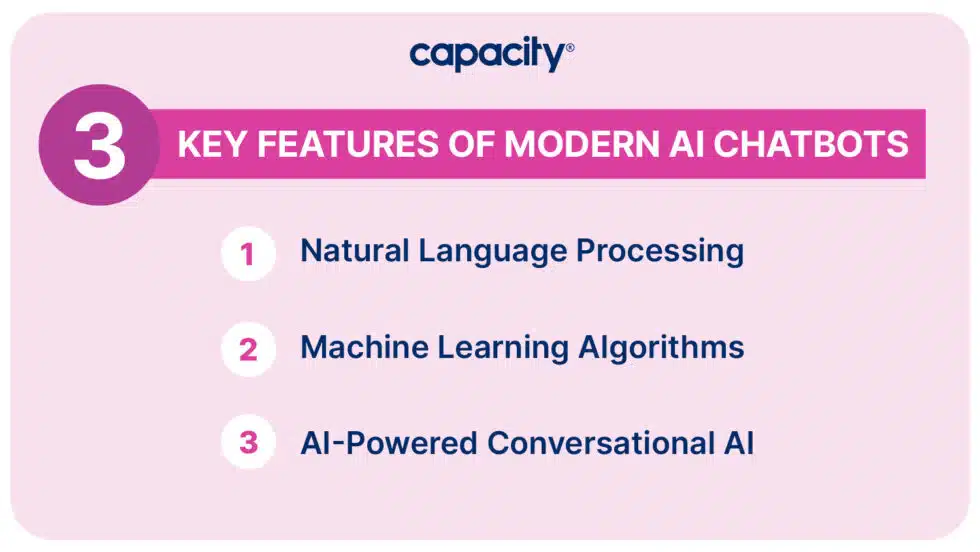
Not every chatbot is your everyday chatbot because each chatbot is created for a specific use case. Like some conversational AI tools can help you create content, others can provide expert-led advice, and a few others can perform complex tasks, such as math, reasoning and science.
Let's break down the different types of chatbots that help business owners handle multiple tasks and keep getting smarter over time.
These chatbots apply predefined rules to respond. It works well for straightforward, high-volume queries but may pass tricky issues to humans.
They scan messages for specific words or phrases like return or shipping and reply with the matching answer. At the same time, they’re easy to setup and get stuck when context matters.
These chatbots use Natural language processing to respond to users engagingly and conversationally. These are ideally used for customer service and support.
Usually, ChatGPT-type chatbots, Claude and Gemini, fall under this category.
These chatbots handle repetitive tasks in workflows or take care of behind-the-scenes processes to accomplish a specific task.
It collects information, triggering notifications, sending emails or invites without touching the data.
These chatbots help customers fix problems by guiding them through the troubleshooting steps. If the issue can’t be resolved, they can pass on the conversation to a human agent. This reduces response times and improves customer satisfaction.
For example, Apple's support chatbot helps users troubleshoot iPhone, Mac, and Apple ID issues and then connects them to an advisor.
These chatbots collect customer feedback by asking short surveys after a purchase or support interaction. This data helps teams understand customer feedback and enhance customer experience.
These chatbots learn from user interactions and feedback, helping them give better responses over time.
These chatbots combine the features from different chatbot types, and that’s why they’re costly to develop as they handle a wide range of requests at the same time.
They blend rule-based structures with AI, delivering predictable answers for simple prompts and intelligent responses for complex ones.
These are flexible bots as they can switch between different types of tasks such as answering questions, processing transactions, or solving customer issues based on their needs.
Whenever users have questions, they often start by interacting with an AI-powered chatbot. These chatbots quickly analyze the input and generate relevant responses within seconds. But the process is far more complex than it seems.
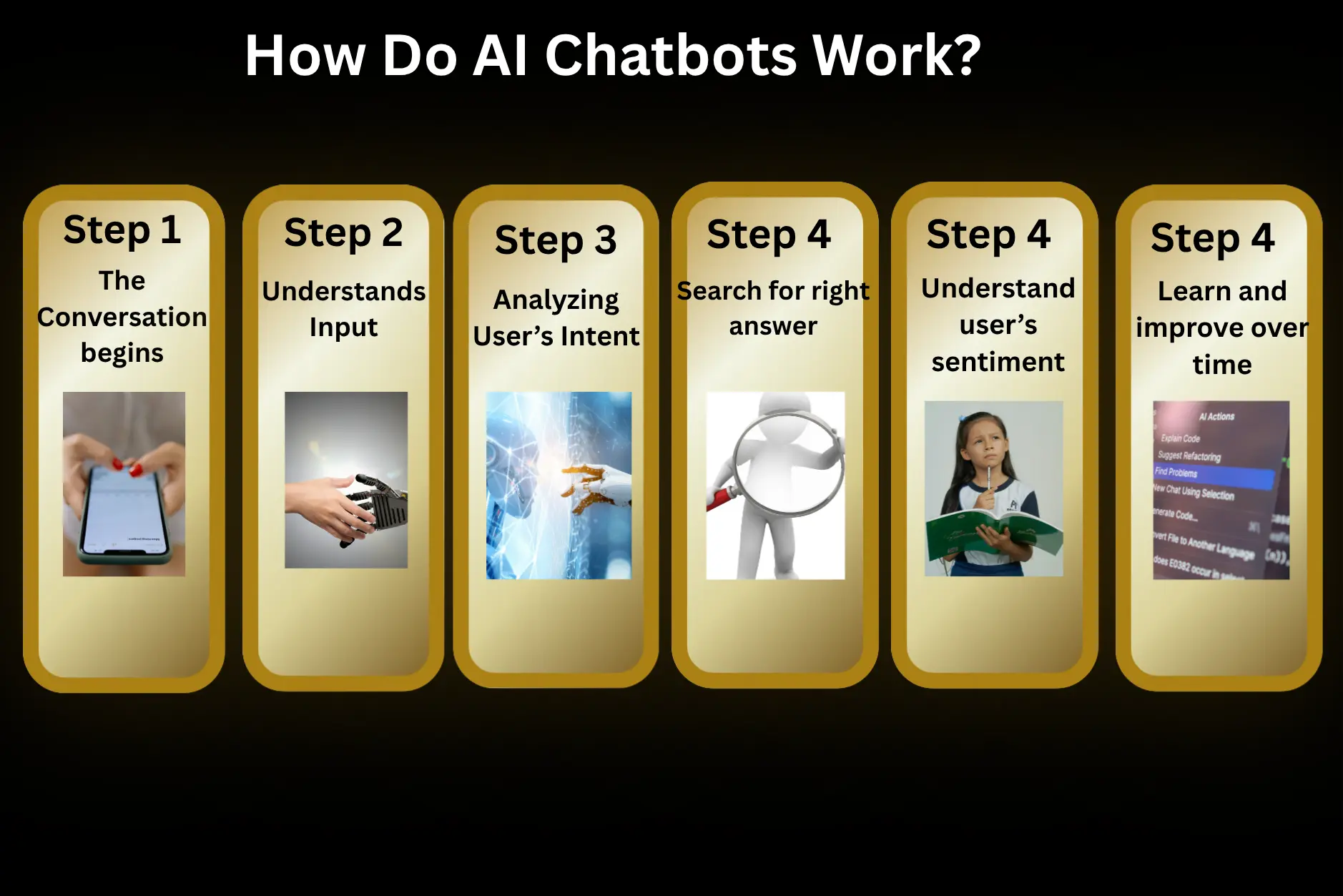
Let’s break down how AI chatbots work, step by step:
The process begins when a customer types a question into the chatbot interface.
The chatbot uses Natural Language Processing (NLP) to interpret the message. NLP helps the chatbot to analyze the sentence structure, extract key information, and identify the user’s intent.
Once it understands the message, the chatbot uses Large Language Models (LLMs), super-smart programs trained on lots of text, to guess what the user’s real goal is and create a response that makes sense.
Chatbots no longer focus solely on matching keywords. Modern chatbots use semantic search, a technology that focuses on understanding the meaning and context of a user's query, to find the best answer from their stored information.
AI chatbots use sentiment analysis to detect how a user feels, so they can give personalized replies, quickly handle urgent problems, and improve overall customer satisfaction.
With the help of machine learning, the chatbot continuously improves with every interaction. It refines its understanding, enhances response accuracy, and adapts to user feedback and past conversations over time.
AI chatbots are becoming essential for businesses. They can handle customer questions, increase engagement, and change how you connect with your customers.
Chatbots are reported to have the ability to increase engagement by up to 90% and sales by 67%.
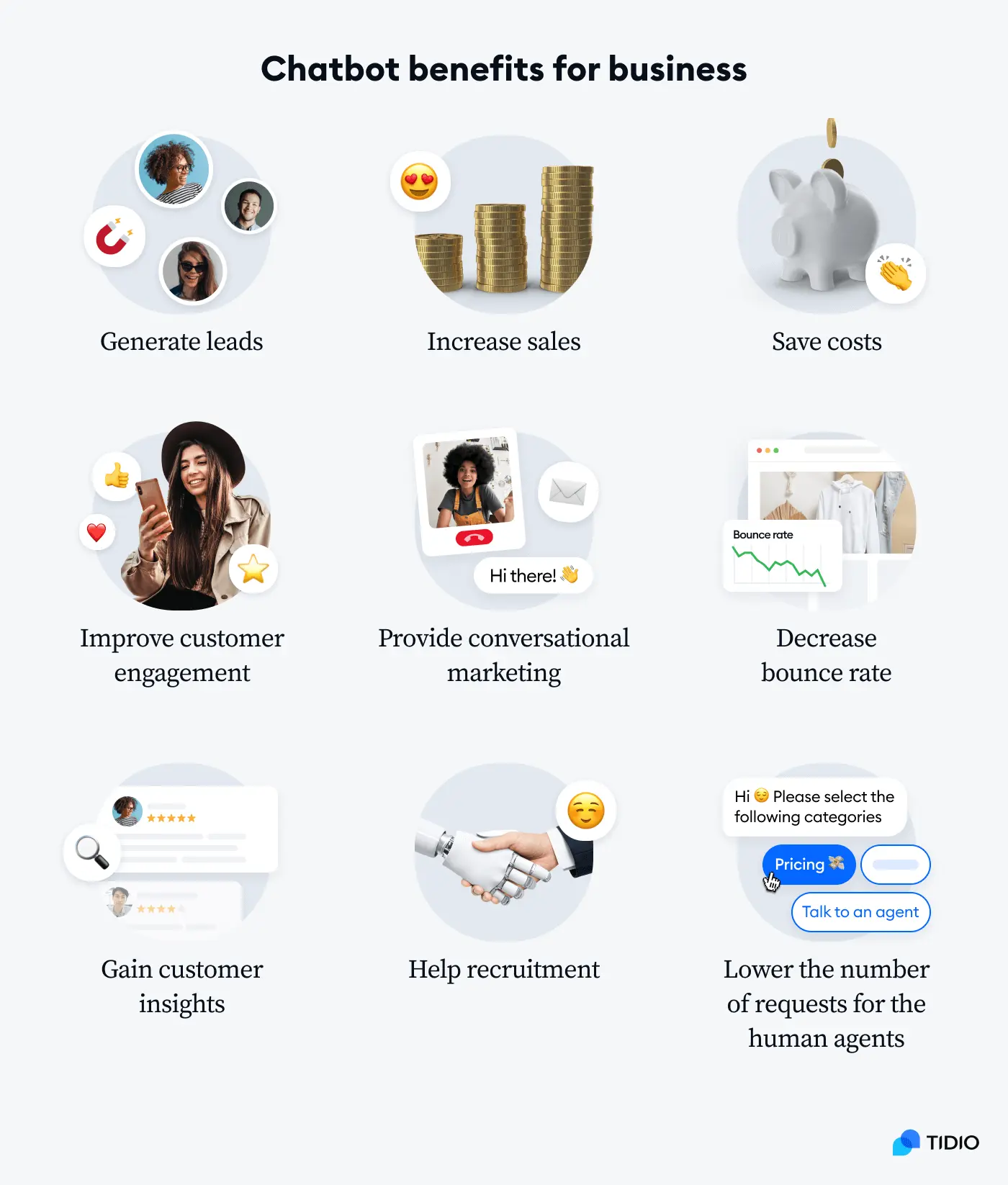
Here are some of the benefits that an AI conversational chatbot offers a business:
According to SmythOS, AI-powered chatbots can resolve 58% customer tickets with an 87% success rate. With the benefits served by AI chatbot solutions in customer service, this statement comes as no surprise.
Earlier, customers had to email or call customer service for answers, which took time, effort, and patience. For businesses, this meant hiring staff, giving them space and equipment, and training them regularly.
Now, with AI chatbots, the process is much faster. They handle many queries at any time of the day, work efficiently, and free your team from repetitive questions. They also avoid human errors and give accurate answers.
You no longer have to make customers wait in long queues or for slow email replies. Chatbots give instant responses, speed up service, and improve the customer experience.
Better service leads to higher engagement, satisfaction, and customer loyalty.
Important fact: AI chatbots can manage up to 80% routine tasks and customer inquiries, allowing human agents to do more productive work and tackle complex issues.
AI chatbots can replace most of your customer service staff. This means you need to spend less on hiring, training, and managing employees, which lowers your operating costs.
While chatbots may have some limits in understanding context, they never need breaks. They can handle peak traffic, work 24/7, and provide extra support when needed. You only step in if a conversation really needs human help.
With instant replies, chatbots help you keep potential customers from leaving, protecting your revenue. They also work across multiple channels and in different languages, making your support more accessible.
This way, you don’t have to increase staff during busy times or maintain a round-the-clock human support team.
Chatbots provide customers with all the required and relevant information immediately. This helps a customer make informed choices about products or services, with complete focus.
This process ultimately helps businesses generate more sales leads and improve their conversion rates. For purchases that require extra attention, particularly where human involvement is necessary, the chatbot can handle the initial interaction, gather key customer information, and assess the buyer’s intent.
Once the lead is qualified, it can then be seamlessly passed on to a trained sales agent, who steps in at the later stages to close the deal more effectively.
AI chatbots help you gain useful insights from customer conversations. They show you where to improve, help you run targeted marketing campaigns, and give customers personalized recommendations.
With conversational chatbots, you can understand customer preferences, track patterns, and improve key metrics like conversion rates and response times.
There are many AI chatbots available in the market, such as ChatGPT, Chatspot.ai, Botsify, and Zendesk Answer Bot. You can avail these chatbots through subscription plans.
No matter which industry you belong to, you can implement chatbots in multiple ways. From reducing support times to generating qualified leads for the sales team to simplifying content generation tasks, AI chatbots can do more than this.
In today’s world, buyers expect instant answers, and if you’re leaving their inquiries in your inbox, then it means leaving money on the table.
Imagine if you feed a lot of general keywords to your chatbot and it can answer frequently asked questions; then it frees up your sales reps to focus on complex tasks. This makes the lead generation process hell easy.
For example, a visitor lands on your ecommerce website, and he asks which running shoes are best for flat feet. The chatbot recommends suitable products, shares the size guide and provides links related to buying guides or product pages, helping the customer make a purchase.
Smart chatbots supercharge customer service because instead of customers waiting for help, AI bots provide consistent support and ensure that customer gets the help when needed, allowing reps to focus on challenging issues.
From generating instant answers to analyzing user preferences to sending personalized responses, it makes the customer experience and their conversations more tailored.
Unlike human agents who work for limited hours, these customer service chatbots are available anytime, anywhere and across different time zones.
Marketing teams use AI-powered chatbots to get more work done. From analyzing customer insights to refining marketing campaigns and improving product offerings, such conversational AI tools make it easier for businesses to reduce friction in customers’ journeys.
AI chatbots recommend products to customers based on customers’ browsing history, track orders, send abandoned cart reminders and help businesses manage inventory and detect fraud.
These tailored recommendations not only enhance the shopping experience but also increase the likelihood of sales.
For example, if the chatbot saw that customers left the product in the shopping cart, then it would remind users about items left behind or offer a discount code to recover the sale. That’s how such ecommerce chatbots help to re-engage the customers who abandon their carts.
In the healthcare industry, medical chatbots make life easier for patients by giving them round-the-clock access to answers and simplifying appointment booking.
For example, while onboarding patients, the healthcare chatbot can be used to create conversation flows to guide them.
It can even create and send educational videos for patients to watch and review at their convenience. The bot can send messages to patients, while patients can interact with bots, asking them about their dosage and scheduling any follow-up appointment.

In the transportation industry, AI-powered tools can handle routine queries related to tracking shipments or providing quotes, suggest solutions for delays, and generate detailed reports on orders delivered.
They can even analyze live traffic data to improve traffic signals and reduce congestion.
AI chatbots make booking easier, provide guest support and offer personalized recommendations. They can also enable contactless check-in, predict when rooms need cleaning and recommend menu items based on guest preferences.
Before picking up the best chatbot for your business, here are a few things you need to take care of -
Find out why you need to deploy an AI chatbot on your website or WhatsApp. Are you cutting more costs, closing more sales, or freeing up the team from repetitive questions?
A customer service goal needs a bot built for resolving common queries; a sales goal needs one that can recommend products and handle transactions.
A generic bot says, "Orders ship in 3-5 days." A bot wired into your actual systems says the customer's order shipped yesterday and will land on Thursday. Ask vendors directly how they connect to your CRM, order system, and policy docs. Vague answers are a red flag.
BigOhTech's chatbots use RAG to pull answers from your internal knowledge base and policy content, so responses reflect what's actually true for your business. Update a policy or add a product, and the bot's knowledge updates too, no retraining needed.
At BigOhTech, our chatbot developers connect chatbots to your CRM, ERP, and ticketing systems via APIs, so the bot can check an order status or update a record instead of just describing what should happen.
Figure out if you need a developer for every tweak or if your team can handle changes themselves. A simple rule-based bot can be deployed in a few weeks; a full generative AI assistant with voice and deep integrations can take two to three months.
You don't need to solve everything on day one. Begin with something manageable, like FAQs, and expand as you learn what actually works.
Choosing the right AI chatbot isn't about picking whatever tool has the flashiest demo. It comes down to knowing what you actually want the bot to do, whether it can tap into the data your business runs on, and whether your team has what it takes to keep it running well after launch.
Get those three right, and your AI powered chatbot stops being a novelty and starts being something your customers and your team actually rely on.
If you're ready to build something that fits your business instead of a generic script, that's exactly where BigOhTech comes in.
As an AI chatbot development company, we design chatbots grounded in your real data, connected to the systems you already use, and built to handle the messy, unpredictable ways people actually ask questions.
From consulting through deployment and beyond, we stick around to make sure your chatbot keeps getting smarter, not just launched and forgotten.
Ready to build an AI chatbot that works as hard as your team does?
If your team spends time answering repetitive questions, qualifying leads, or handling high support volumes, an AI chatbot can automate these tasks and improve response times.
The cost of building an AI chatbot for enterprise ranges between $30,000 to $250,000+ and more. Cost depends on factors such as integrations, data preparation, compliance and security, vector databases, maintenance cost etc.
The ROI of an AI chatbot includes reduction in support costs, faster response times, higher customer satisfaction score, and increased conversions often delivering significant returns within months of deployment.
This depends on multiple factors. But an AI chatbot can typically be implemented within a few days to a few weeks, depending on the complexity, required integrations, and customization level.
Yes. AI chatbots can securely access internal documents and knowledge bases using role-based access controls, encryption, and permission-based retrieval, ensuring users only see information they're authorized to access.
Pretty much anywhere your customers already are your website, mobile apps, social platforms like Facebook Messenger and Instagram, messaging apps like WhatsApp and Slack, e-commerce platforms like Shopify, and customer service tools like Zendesk or HubSpot.
Most modern AI chatbots are built for multi-platform deployment, so you're not stuck picking just one.
Benefits of using chatbot for businesses include 24*7 customer support, reducing operational costs, lead generation and handling large volume of customer inquiries.
AI chatbots help businesses by answering their FAQs, providing product details, tracking orders, booking appointments, gathering customer feedback and handling basic transactions.
Basic chatbots follow the predefined rules to provide responses, whereas AI powered chatbots understand use machine learning to understand conversations and provide natural, conversational responses.
Yes, the AI chatbots that we provide can be easily integrated with CRM platforms, ticketing systems, and knowledge bases to provide context aware responses.
The biggest mistakes businesses make when choosing AI chatbots are choosing the wrong use case, skipping chatbot training, and not integrating it with existing business systems. This often leads to poor customer experiences and low adoption.
Buy if you need a chatbot for FAQs or customer support quickly. Build if you need custom workflows, proprietary data integration, or industry-specific compliance.


•
Sr. Technical Writer•
Articles