List of Famous Apps Development in Flutter Framework
Share this blog:

With so many businesses expanding, cross-platform apps are gaining more popularity. And multiple frameworks facilitate the development of these apps. Flutter is one such framework. In this blog, we will learn a bit about this framework and list the famous apps developed in Flutter.
Flutter is an open-source, and free mobile UI toolkit or framework for the creation of cross-platform apps. It was developed by Google and released in 2017. Developers could create complex UIs on multiple devices regardless of their operating systems, from a single codebase using Flutter.
Flutter is preferred by many businesses for app development due to its multiple impressive features and functionalities. It facilitates the creation of cross-platform apps, in a time- and cost-effective manner.
It has two key components:
Also Read: Most famous Flutter local database in 2023
Over 10k apps have been released in the market using Flutter. In fact, as per a 2022 developer survey.Flutter is the most popular cross-platform mobile framework used by global developers.
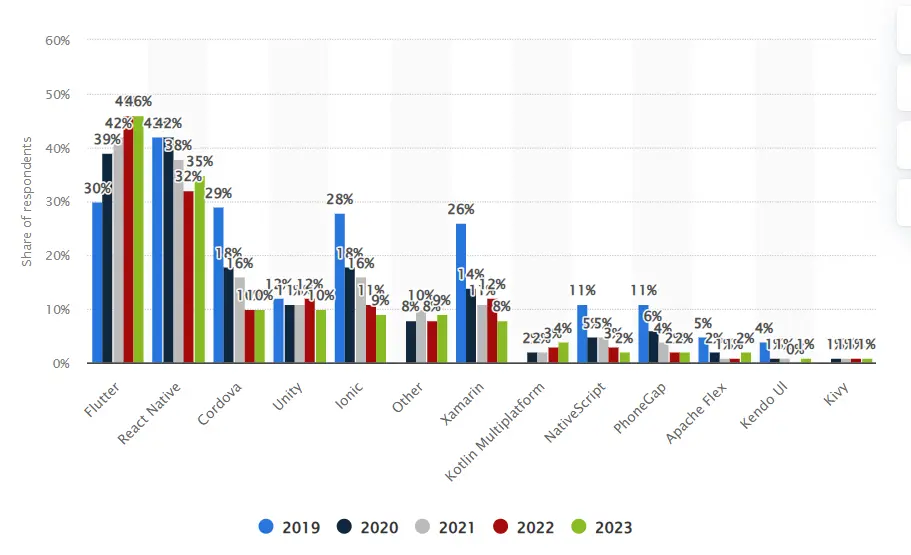
Flutter gives developers and businesses the following benefits:
Cross-platform apps allow businesses to leverage the audience of two of the most popular operating systems namely Android and iOS, and more. Flutter is one of the most widely used frameworks for the creation of these apps.
Launched by Google, the framework is behind the development of some of the most popular and used Google-backed products such as Google Pay, Google Ads, and no longer running, Google Stadia.
Other companies have leveraged this framework too and the list of the same is long. Let’s look at the list of companies that have used Flutter to build their business apps.
Since Flutter was developed by Google, multiple products by the tech giant have been backed by it. Google Stadia was a game streaming platform that was developed using the Flutter software development kit (SDK).
Flutter has also been behind the development of Google ads. Using this framework, Google has created a digital marketing tool that is cost-effective and efficient. They pay only after users click on their ads. This platform allows for targeted marketing and an intuitive UI makes performance tracking and optimization possible.
Google Pay has also been developed using the Flutter framework. Since it is a global digital payments app and must cater to the local requirements of every region, the development of native apps seemed like a waste of resources. So, Flutter was the perfect solution.
Google team witnessed a 35% reduction in the code lines and a 70% reduction in the engineering efforts.
Flutter was initially tested as an Add-to-app possibility by the Google Pay team. However, the team could not ignore the possibility of rewriting the entire app. Although it required a heavy upfront investment of engineering resources, the team saw an opportunity to enhance the speed and efficiency of its client development for faster response as well as implementation times, among other things.
The key point, however, was that migration to Flutter will facilitate faster, and resource-efficient scaling of Google Pay globally. While building out features on native platforms required more effort, perhaps double, Flutter would require 1.2 times as much work. Therefore, the team decided to go with Flutter, which turned out to be a great gamble.
‘Everyone loved Flutter — you could see the thrill on people’s faces as they talked about how fast it was to build a user interface’, said David Ko, Engineering Director, Google Pay.
The tech giant also uses Flutter for various panels of the Google Assistant and the UI of the Google Home hub.
The New York Times was struggling to keep pace with the digital era. The company was constantly looking for digital ways to keep its users engaged as well as enhance their experience. The company finally launched its KenKen puzzle app built with Flutter, besides its main mobile app.
With a single codebase, the company introduced the app for multiple platforms and devices such as iOS, Android, macOS, web, etc.
eBay is a popular retail platform. This platform used Flutter to develop one of its automotive products, eBay Motors. This product facilitates the trade of vehicles as well as vehicle parts and accessories. It features an Escrow payment system and offers chat space, new listing alerts, and save search options.
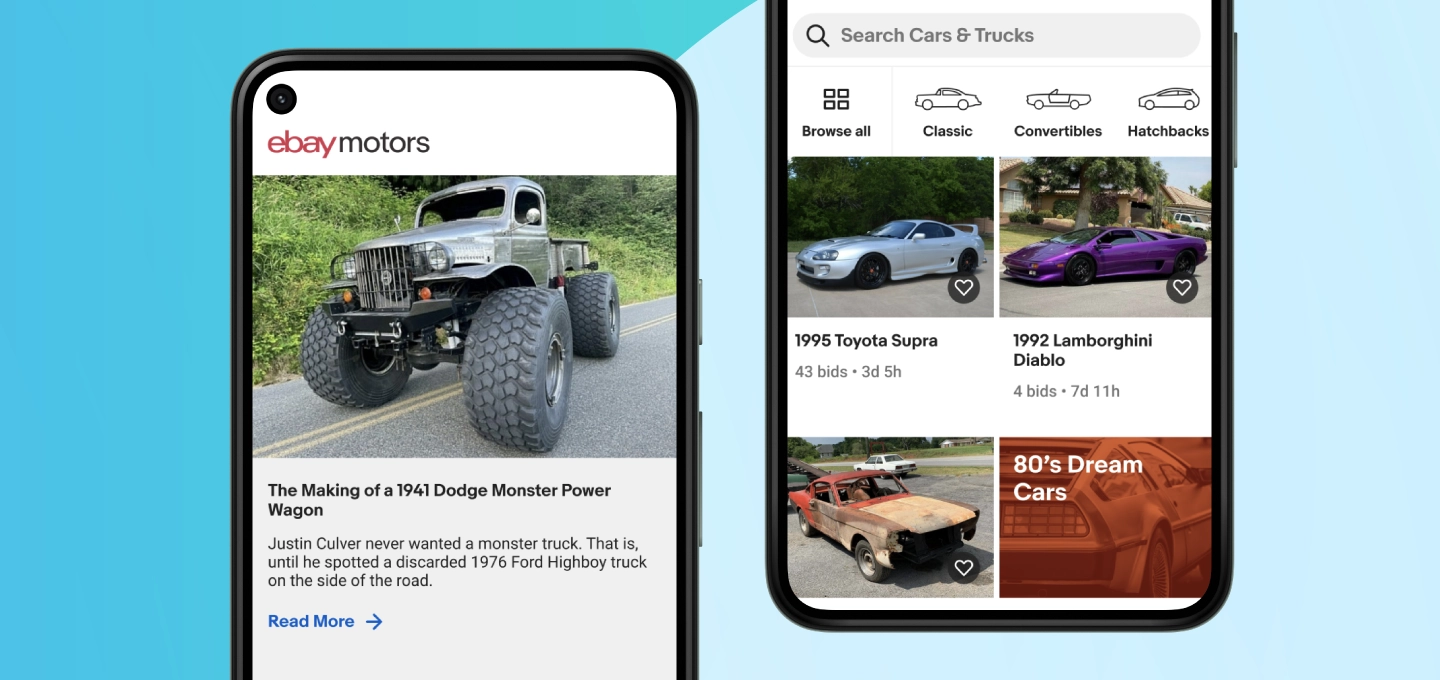
The team at eBay had time constraints and wanted a platform that would offer all the features eBay users are familiar with, whilst enhancing their experience. They had heard the buzz about Flutter, which had been recently released, and so they decided to give it a shot. Fortunately, it suited their project requirements well. However, before going ahead with the framework, eBay spent a month trying to explore it and discover gaps in its potential. But found none.
There wasn’t a need for platform-specific codes, rapid programming, and a seamless UI, this is all that made Flutter the perfect choice. And Flutter did not disappoint this retail giant. It delivered excellent performance and efficiently managed all the company’s tasks.
In fact, eBay’s Senior iOS Engineer said that ‘Flutter has not only met our expectations — it has dramatically exceeded them.’
The company in its blog post titled eBay Motors: Accelerating with Flutter said, ‘We found that Flutter enabled us to solve interesting problems faster than we anticipated. The development experience was far more enjoyable and we could quickly build a user experience that was very consistent between iOS and Android'.
In an internal survey carried out by the company, 100% of the developers on the eBay Motors team said they enjoyed Flutter development more than iOS or Android. Additionally, 70% said they thought the app development using Flutter was “at least twice as fast.”
Xianyu is a platform that deals in used goods and is managed by the e-commerce giant, Alibaba. Due to the complexity of the used goods market, the company wanted to build an app with user-friendly UI and e-commerce features.

The team explored many frameworks such as React Native, and finally zeroed it down to Flutter.
Bing Sun, a developer at Alibaba Group said, ‘We were immediately intrigued by Flutter possibilities when it comes to UX – including high FPS and smooth UI. But, above all, Flutter was an incredible time-saver. It allowed us to use a single codebase which makes the maintenance of our app much easier and faster.’
Alibaba used Flutter to build 50+ million user Xianyu app (Flutter Developer Story)
Flutter offered an extensive features list, rapid development, and testing with better developer experience and faster time-to-market. ‘The ItemDetail page – the most crucial, complex and frequently visited section – is run through a single codebase on Android and iOS using Flutter’, he added.
With such impressive results given by Flutter, the framework found a permanent seat in Xianyu’s tech stack.
‘Using Dart and single code to implement pages was different from the old habits we used to have, but we fell in love with it as soon as we tried it out. What else can be more fascinating than seeing results right away while editing your code? In no time, we made elegant pages. Wicked!’, concluded Sun.
Groupon is another company that chose Flutter for apps. The app offers exclusive coupons and deals to users for multiple brands and comes in two variants- customer-facing and merchant-facing.
The company did not rewrite the code but instead integrated Flutter with an existing solution and leveraged the benefits of both.
It is an AI-powered, personal journaling app that was originally written in React Native for the iOS platform in 2017. However, when the team wanted to expand it to the Android platform as well, a problem occurred. Because of application movement, the app did not perform well on Android.
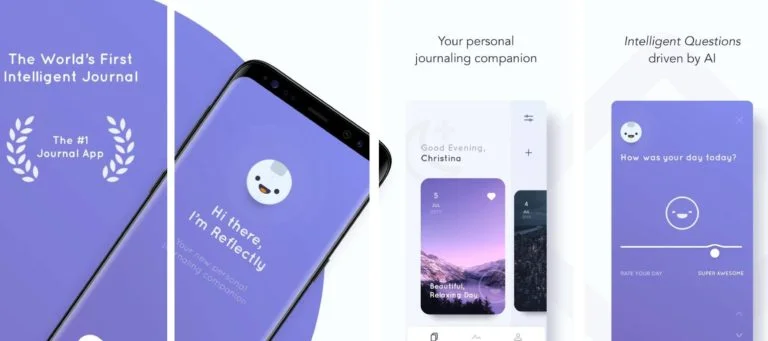
The app required to eliminate the activities to become usable. ‘Reflectly did indeed run on Android, but it was far from what we had hoped it would be like. Overflows failed and as a result, scroll elements went missing, and shadows were cut off in strange ways. Furthermore, animations turned out unbearably sluggish’, said the Reflectly team.
Since the app had gained popularity by then, the team decided to rewrite it altogether in 2018. The team explored Xamarin, but they were too hesitant to use a technology that used to be proprietary. Ultimately, Flutter was chosen for this task.
‘As a former web and native app developer, getting started with Flutter was truly awesome. I know it’s been said before, but the huge power and productivity you get with instant stateful Hot Reload was mind-blowing to me’, said Jacob Kristensen, Founder & CPO at Reflectly.
Reflectly App (Flutter Developer Story)
Despite having only 2 engineers, the Reflectly team was able to rewrite the app and launch it for both the iOS and Android platforms.
‘In our case, from the first line of Flutter code that was written in March 2018, until we were finished with the entire app – including an entire redesign and adding a bunch of new features underway – it took only 2.5 months. This included both the learning curve of Dart as well as an entire rewrite from scratch for both frontend and backend – with 0% code reuse from our previous implementation’, he added.
With Flutter, the team experienced a 50% decrease in the development time.
‘Using Firebase Analytics and Sentry, we meticulously monitored the release for any unforeseen issues as it was being deployed to new and old users. Despite Flutter’s beta label, we did not, and have not, seen any major issues using Flutter in production across hundreds of thousands of users, running on a multitude of different iOS and Android devices’, said Daniel Vestergaard, Co-founder & CTO at Reflectly.
‘Our crash rates are down tenfold, and our users are happier than ever’, concluded Jacob.
Flutter for apps has also been used to develop SpaceX Go. It’s a SpaceX launcher and aims to provide a smooth SpaceX experience to users. From previous rocket launches to recent ones, this app offers all the relevant information.
Users can also read through the catalog of all vehicles and find out more about capsules, rockets, ships, etc. It is one of the most famous apps developed in Flutter.

Back in 2020, BMW launched its highly functional yet lightweight app that allows users to interact with their cars. The app is called MyBMW and was entirely developed in-house using Flutter for apps. It was built for both platforms, iOS and Android.
For a long time, the mobile app team at BMW focused solely on the iOS version of their app. However, in 2018, the automotive giant realized that the feature and design discrepancies between the platforms have grown and become noticeable.
Although it decided that it wanted to offer similar functionality to all its customers across multiple brands, platforms as well as apps, hiring a fresh team for Android development seemed to be time-consuming and a costly affair.
Thus, the BMW team started exploring cross-platform options. Initially, the team was concerned that Flutter was not yet mature enough for the scale at which BMW needed to operate. As a solution, they designed various proofs-of-concept with every other framework.
However, every other platform failed to check the box when the BMW team decided against web-based content for a better UX. And as a result, it settled for Flutter. Within a year, the My BMW App was launched in July 2020, with the help of a single codebase across different platforms.
Toyota, the popular automotive brand has also used Flutter for its systems. It has built its infotainment systems with the framework to overcome slow performance and create a smoother user experience in the car’s embedded systems.
The automobile company felt that its customers expect similar high levels of performance in the company’s infotainment systems as they do from the driving experience. Thus, they decided that the experience on-screen should match the Toyota look and feel.
Intrigued by Flutter and its freshly released support for embedded systems, Toyota formed a partnership and started development. The team was quite happy with Flutter’s high-performing rendering engine and features such as AOT compilation.
Additionally, the company felt more invested and confident in the framework due to the developer experience of Flutter. The hot-reload feature on desktops and other devices proved to be useful in user testing and helped Toyota collect timely feedback for better UX.
‘Flutter's open-source principles and high-growth developer community have been critical to our success’, said Daniel Hall, Chief Engineer, Toyota Motor North America.
A lot of famous apps have been developed in Flutter by some of the most popular companies. It is a lightweight framework that facilitates the creation of cross-platform apps and ensures performance efficiency.
Flutter for apps ensures rapid development, smooth developer experience, quicker testing capabilities, and faster time-to-market than the other options available in the marketplace.
Yes, Flutter allows developers to build applications for both Android and iOS using a shared codebase.
Yes, Major Companies such as Google, BMW, eBay, Alibaba, and Toyota have used Flutter in production
Flutter allows developers to share code across platforms, reducing duplicated development work and making updates and maintenance more efficient.
Yes, Flutter is a strong option for businesses that want to build and maintain applications across multiple platform from a single codebase.
By sharing code across platform, businesses can reduce the amount of duplicated platform-specific development and maintenance work.
yes, Bigohtech offers Flutter migration service for application build with technologies such as java, Objective-C, React Native and other legacy stacks.
Flutter apps can use appropriate encrytion, secure authentication, access controls, and secure
backend/API practices to protect sensitive user information. The overall security depends on the complete application architecture, not Flutter alone.
BigOhTech follows enterprise-level security and compliance practices, including ISO 27001 and GDPR.
The cost of Flutter app development depends on factor such as app complexity, features, UI/UX requirement, integration, platform, and development time.Flutter can help reduce development costs by allowing businesses to use a shared codebase across platforms.
Yes, Flutter supports multiple languages.
Yes, Flutter apps can integrate with payment gateways and third-party payment services. However, payment security depends on the complete implementation, including secure APIs, authentication and data handling.
Yes, Flutter is suitable for eCommerce application because businesses can build application for multiple platforms using a shared codebase. It can also integrate with APIs, payment services, authentication system, and other third-party services required by an eCommerce application.


•
Sr. Technical Writer•
Articles